
Mattancherry
Artiko Tales
- 1 activity here
- 40 participations here
Mattancherry
A medium-sized indoor art studio on the first floor in Jew Town, with electricity and basic lighting. It suits workshops, art sessions and small group activities.
What happened here
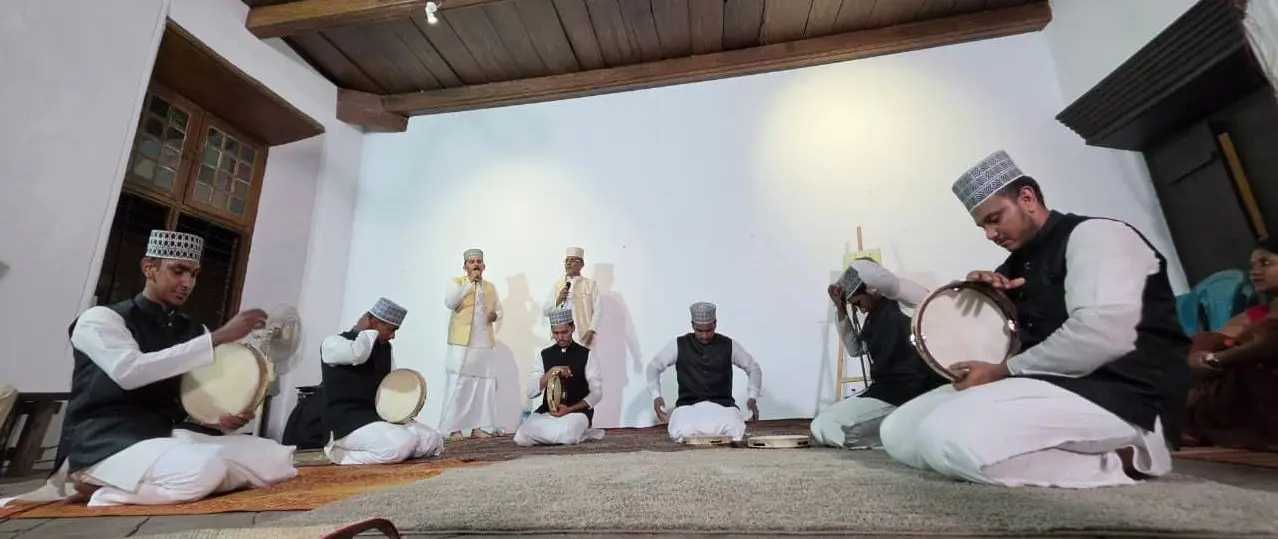
Friends of Thudippu – Fifth Edition: Discovering the Living Traditions of Daffmuttu and Arabanamuttu
The fifth edition of Friends of Thudippu featured a rhythmic powerful performance of Daffmuttu and Arabanamuttu by Koya Kappad and his team at Mattancherry. The event brought audiences closer to the rich folklore and cultural heritage of Kerala, creating an experience that went beyond a conventional performance. Koya Kappad, a seventh-generation practitioner from a family associated with these art forms, presented the traditions with remarkable energy and depth. The art forms were popularised in the Malabar region by the Allasammveetil family, a Yemeni family that arrived in the Kappad region of Kozhikode in the fifteenth century. The family has continued to pass these traditions down through generations, with the guru tradition inherited patrilineally. Koya Kappad represents the latest generation of this lineage. One of the most meaningful aspects of the programme was the way Koya Kappad shared the history and context of the art forms alongside the performance. He introduced the audience to the rhythms and talam used in the traditions, demonstrated how they worked, and encouraged audience members to try them together. This interactive approach transformed the event into an engaging learning experience, allowing the audience to understand and participate in the art forms rather than simply watch them. The performance created a strong impression on the audience, many of whom were experiencing these art forms for the first time. The audience response was enthusiastic, and the programme highlighted how live performance, storytelling, and interaction can help people connect with cultural traditions that may otherwise remain unfamiliar to them. Organising this edition involved several months of research into Kerala's folklore traditions, identifying the art form and artist, coordinating the venue and performance requirements, preparing promotional materials, and reaching out to potential audiences. The team also managed event-day arrangements, artist hospitality, documentation, and technical coordination. The event also brought important organisational learnings, particularly around sound and lighting. Despite challenges with the microphone, sound support, and the lighting provided at the venue, the team worked to ensure that the programme could continue. These experiences helped us recognise the importance of confirming technical requirements in advance and choosing venues with reliable basic sound and lighting facilities. Friends of Thudippu was created to provide a platform for Kerala's rich art forms and the communities and practitioners who sustain them. This edition reaffirmed our belief that preserving cultural heritage requires more than documentation; it also requires creating opportunities for artists to perform, share their knowledge, and connect with new audiences. We see this as an important responsibility towards sustaining the living cultural heritage of our state.